Setting Credit Limits That Fit
Yesterday's risk snapshot ended with "approve with a low limit." Today's question: how low? How do you actually pick the number?
In most businesses, honestly, the number is a guess. Sales asks for 20,000, the last customer got 15,000, this one "feels similar," done. The problem with gut-feel limits isn't that they're always wrong — it's that they're inconsistent and unreviewable. Nobody can say why Customer A got double Customer B's limit, so nobody can learn from the ones that go bad.
A credit limit is really a bet: you're wagering that this customer will pay for what you ship before you ship more. Good limit-setting means sizing the bet so your business survives being wrong.
The limit logic: three forces
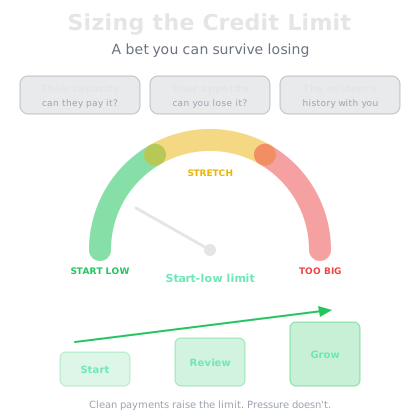
Every sensible credit limit balances three things:
Their capacity. Can they realistically pay this much within terms? Their net assets, cash position, and size are the ceiling. A limit that's large relative to a customer's whole balance sheet is a fantasy, not a limit.
Your exposure. What does losing this amount do to you? A limit that would sting is a business decision; a limit that would sink you is a mistake, no matter how good the customer looks.
The evidence. How much verified history do you have? A prospect with a glossy pitch has zero payment history with you. Twelve months of clean payments is real evidence — and limits should grow with it.
Which leads to the single most useful rule in limit-setting: start low, grow with history. A modest opening limit costs you almost nothing — if the customer is genuine, they'll trade within it for a few months and you'll raise it on evidence. If they push hard against a cautious starting limit before shipping a single order, that itself is information.
A simple rubric AI applies consistently
You don't need a data-science team. A five-factor rubric scored 1–5 covers most B2B situations:
Financial strength — net assets, profitability, trend. Payment behavior — days beyond terms with other suppliers, judgments. Trading history with you — none, some, or long and clean. Sector and situation — stable industry or stressed one, concentration risk. Information quality — recent full accounts and references, or stale abbreviated filings.
Add the scores: high scores earn a limit near what their capacity supports; mid scores get a fraction of it; low scores mean minimal credit, or payment up front until history builds. Your own thresholds will depend on your margins and risk appetite — the point is that the same customer facts always produce the same limit.
This is exactly where AI shines. Humans apply rubrics inconsistently — Friday-afternoon generosity is real. AI applies the same rubric the same way every time, shows its scoring line by line, and drafts the file note. Then a human — you, or whoever holds credit authority — approves, adjusts, or overrides the number. An override is fine; an undocumented override is how gut-feel sneaks back in.
Limits are living numbers
A limit set once and forgotten quietly rots. Build in review triggers — events that force a fresh look:
Late payments — an on-time payer drifting to 15, then 25 days beyond terms is telling you something. Order spikes — a sudden order far above their normal pattern can be great news or a customer loading up before trouble; look before you ship. Adverse news — new judgments, late filings, lost contracts, sector shocks. On Day 11 you'll turn these into a full early-warning system; for now, just make sure every limit has a review date and a trigger list attached.
Notice what you've built across two days: check the customer (Day 3), score and size the limit (today) — a repeatable onboarding decision that takes minutes and stands up to scrutiny. Tomorrow, the final piece before the first invoice: the paperwork — applications, terms, retention of title, and guarantees.