AI-Assisted Customer Credit Checks
A new customer wants credit terms. Sales is excited, the order is big, and everyone wants a fast yes. This is the exact moment most bad debt is born — because every bad debt was once a new customer someone didn't check properly.
The check itself isn't hard. What kills it is time pressure: a proper review means reading filed accounts, a credit report, and court records while sales taps their watch. Today you'll learn what to look at — and how AI compresses that reading from an hour to minutes, so "we didn't have time to check" stops being a reason.
What to look at before extending terms
Five sources tell you most of what you need:
Filed accounts. Most companies must file some level of accounts publicly. Look at whether they're profitable, whether they have more assets than liabilities, and which direction the numbers are moving. Late filings are a signal in themselves.
Payment history. Credit reference agencies report how a company typically pays its suppliers — on time, or consistently stretching terms. Past payment behavior is one of the strongest predictors of how they'll pay you.
Court judgments and liens. County court judgments (or your jurisdiction's equivalent), liens, and legal charges against the company mean other creditors have already had to force the issue. Treat them seriously.
Sector risk. A structurally struggling industry raises the risk of even a well-run customer. Their biggest customer's problems can become your problem.
Director history. Directors with a trail of dissolved or failed companies deserve a closer look. It isn't automatically disqualifying — but it changes the questions you ask.
No single source decides it. You're building a picture.
AI turns documents into a risk snapshot
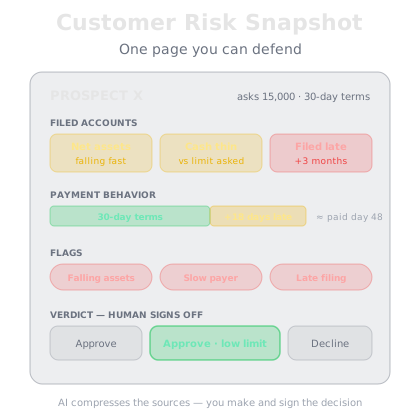
Here's where the hour disappears. Credit reports and filed accounts are dense, jargon-heavy documents. AI is exceptionally good at reading them and producing a one-page risk snapshot: key financials, payment behavior, red flags, and the questions you should ask before saying yes.
The workflow: take the key figures and facts from the credit report and accounts, anonymize them (call the company "Prospect X" — the same hygiene rule as Day 2), paste them into your assistant, and ask for a structured snapshot with a recommendation and reasoning.
Two rules keep this honest:
Triangulate — AI summarizes sources, it isn't the source. Never ask a chatbot "is Acme Ltd creditworthy?" and trust the answer. It may hallucinate or rely on stale information. The data comes from credit agencies, filed accounts, and public registers; AI's job is to compress and structure what you feed it.
Document the decision. Save the snapshot, note what you decided and why, and date it. When an account goes wrong two years later — or when an auditor asks — "we reviewed X, Y, Z and approved a low starting limit on this basis" is worth a lot. AI even drafts that file note for you.
And the decision itself? Yours. AI recommends; a human approves every new account and every set of terms.
Fast enough to always happen
Notice what the demo produced: a defensible middle path. Not "decline" (sales keeps its customer), not a blind "yes" to 15,000 — a small limit, a review date, and two sharp questions. That's a better decision than most gut calls, and it took minutes.
Speed is the real win here. When a proper check takes five minutes instead of an hour, it actually gets done — for every customer, every time. The check that doesn't happen is the one that becomes next year's write-off.
Tomorrow: the snapshot said "approve with a low limit" — but how do you size that limit? You'll build a simple, consistent method for setting credit limits that fit.