Application & Affordability Analysis in Minutes
Days 1–3 gave you the map, the toolkit, and the theory. Today is the payoff lesson — the workflow you'll use more than any other in this course: AI-assisted application review.
A typical consumer or small-business file means an application form, months of bank statements, payslips or accounts, and supporting documents. Read properly, that's a solid chunk of your morning — per file. Today you learn to turn that reading into a structured first-pass summary in minutes, so your time goes where it belongs: verifying and deciding.
Step one: summarize the pack
Every application review starts the same way: what am I actually looking at? Instead of building that picture by flipping between PDFs, give an AI (approved tool, anonymized data — Day 2 rules always apply) the pack's contents and ask for a structured snapshot:
"Summarize this loan application pack into: applicant profile, loan request and purpose, stated income vs documented income, existing commitments, and anything incomplete or inconsistent across documents."
That last clause is quietly the most valuable. AI is good at noticing that the stated salary doesn't match the payslips, that an address differs between two documents, or that one bank statement month is simply missing. Those cross-document checks are exactly what tired human eyes skip at 4pm on a Friday.
Step two: the affordability workup
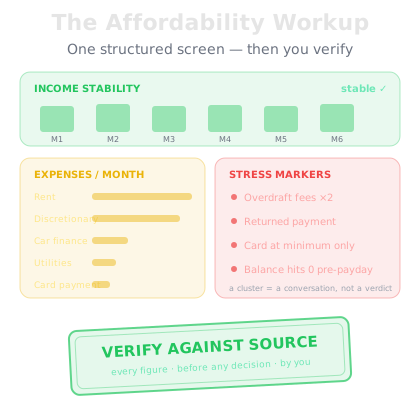
Now the heart of the review: can this applicant afford this credit? From anonymized statement data, AI can build the workup fast if you tell it exactly what to look for:
Income stability — How regular are the credits? Same employer, same rhythm, same amounts? Is there secondary income, and does it persist across months or appear once?
Expense patterns — Fixed commitments (rent, utilities, insurance, existing repayments) versus discretionary spend. What's left over each month, and how much does that figure swing?
Debt stress markers — The quiet warnings: overdraft fees, returned payments, balances that hit zero before payday, minimum-only card payments, new credit taken mid-period, gambling patterns. Any one of them is a question; a cluster is a conversation.
The point isn't that AI sees things you couldn't. It's that AI reads every line of every month with equal attention and hands you an organized picture — while you'd still be on statement two.
Step three: a prompt that makes every review consistent
The real professional win isn't speed — it's consistency. The same file reviewed by two analysts (or by you on a good day vs a bad one) should surface the same picture. A structured prompt is how you get that. Save this one:
"You are assisting a credit analyst. From the anonymized statement data below, produce a review with exactly these sections: 1) Income — sources, amounts, stability rating with evidence. 2) Fixed commitments — itemized monthly total. 3) Discretionary spending — pattern and monthly range. 4) Debt stress markers — each with the specific transaction evidence. 5) Affordability summary — net monthly surplus, best and worst month. 6) Questions a human reviewer should resolve before any decision. Flag every figure that should be verified against source documents."
Same sections, every file, every time. Your memos get easier to write, your reviews get easier to compare, and nothing gets forgotten because the template doesn't allow forgetting.
Verify like it's your signature — because it is
One discipline makes this whole workflow safe: every number gets checked against the source documents before it influences anything. AI occasionally misreads a figure, merges two transactions, or — importantly — sounds most confident exactly when it's wrong. Treat the workup as a brilliant junior analyst's draft: it structures your thinking and saves you an hour, and you'd never sign it unread.
That's the shape of the daily win. The reading compresses; the verification and judgment stay human-sized. Multiply that across every file you touch this week and you'll understand why this is the lesson people come back to.
Tomorrow: the same cross-checking skill, pointed at a darker problem — spotting fraud red flags at origination.