Fraud Red Flags at Origination
Yesterday you compressed a 40-minute file review into a 10-minute verification pass. Today's question: while you're reviewing faster, what are you reviewing for?
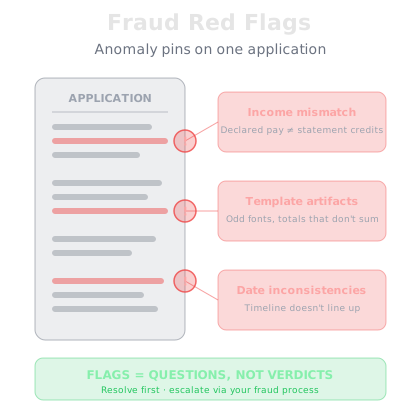
Application fraud walks in the front door looking like a normal file. The declared income that doesn't match the bank statements. The payslip with slightly-off formatting. The applicant whose credit history started suspiciously recently. Experienced underwriters develop a nose for these patterns over years — and AI can act as a tireless second pair of eyes that cross-checks every document against every other document, every time.
One thing before we start: this lesson teaches you to recognize patterns, not to investigate or accuse. A red flag is a question, never a verdict. Your organization has a fraud process — everything AI surfaces feeds into it, nothing bypasses it.
The patterns that show up again and again
Fraud teams see the same broad categories on repeat. You should be able to name them:
Income inflation — Declared income that doesn't line up with what actually lands in the account. The story the application tells and the story the statements tell are two different stories.
Document tampering signs — Payslips or statements where something is subtly off: inconsistent fonts, misaligned columns, totals that don't sum, employer details that don't match public records. Genuine documents are boringly consistent; altered ones tend to have small internal contradictions.
Synthetic identities — Profiles assembled from mixed real and fabricated details. The tell is usually a history that's too thin, too new, or too tidy for the age and profile claimed.
Coached applications — Batches of applications that read strangely alike: same phrasing, same employer types, same round-number incomes. Individually plausible, collectively suspicious.
None of these alone proves anything. A mismatch can be a bonus month, a new job, a legitimate name change. That's exactly why they're called red flags and not red cards.
AI as a consistency engine
Here's where AI earns its seat. A large language model is genuinely good at one thing you do slowly: holding an entire file in view at once and checking whether it agrees with itself.
Give it the anonymized facts from an application — declared income, employment details, statement summary, stated expenses, the applicant's narrative — and ask it to list every internal inconsistency it can find. It won't get tired on file 30 of the day. It won't skim the statements because the payslip looked fine.
A prompt pattern you can reuse:
"You are assisting a lender's application review. Below are anonymized facts from one application: declared details, document summaries, and statement figures. List every internal inconsistency or unusual pattern, one per line, each with: what conflicts with what, and one innocent explanation that could account for it. Do not conclude whether fraud is present."
That last sentence matters. You're asking for anomalies plus innocent explanations — which keeps you honest about false positives and keeps AI in the analyst seat, not the judge's chair.
And the standing rule from Day 2 applies with extra force here: fraud review files are full of PII. Anonymize before you paste, always — or use your bank's approved enterprise tools.
False positives — and why your process still rules
Run consistency checks on enough honest applications and you'll see flags everywhere. New jobs, side income, family support, sloppy scans, payroll providers with confusing names — real life is messy, and messy looks like fraud from a distance.
That's why the discipline has three steps, and AI only owns the first:
1. Detect — AI lists anomalies, tirelessly and consistently. Its job ends here.
2. Resolve — A human asks the follow-up questions and checks the source documents. Most flags dissolve into paperwork requests.
3. Escalate — Anything that survives resolution goes into your organization's fraud referral process — the same one you'd use if you'd spotted the pattern yourself. AI changes how early you see the anomaly. It changes nothing about who investigates, who decides, or how the applicant is treated in the meantime.
Treating a flagged applicant as guilty is how good customers get lost and complaints get upheld. Treating a flag as a question is how fraud gets caught and honest applicants get approved.