Day 5 of 14 · AI for Parents
How to Talk to Your Kids About AI
⏱ 6 min
📊 Beginner
You now know more about AI than most parents. Time for the part that actually changes things: talking to your kid about it.
First, the rule that makes everything else work: "just don't use it" fails. It failed for the internet, it failed for social media, and it fails faster for AI — because AI is built into the apps and homework tools your kid already uses. A ban doesn't stop the behavior. It stops the conversation, and pushes the behavior somewhere you can't see it.
The parents who stay in the loop aren't the strictest ones. They're the ones their kids voluntarily show things to. That's the position you're playing for — and curiosity gets you there, interrogation doesn't.
Conversation starters by age
The right opener depends on the kid. Same goal every time — get them talking, keep them talking — different door in:
Ages 8–11: make it a game about the machine. Try: "Did you know the computer can make things up and sound totally sure about it? Want to try to catch it being wrong?" At this age, "AI sometimes lies confidently" is a fun fact, not a lecture — and it plants the most important habit early: don't trust it blindly.
Ages 12–14: make them the expert. Try: "Show me the coolest thing you've done with AI." Kids this age light up when they get to teach you. You'll learn more about their actual usage in ten minutes of being shown around than in ten interrogations — and you've established that showing you things is safe.
Ages 15–17: ask their opinion like you mean it. Try: "Where do you think the line is on using AI for school?" Teens can smell a trap question. But asked sincerely, most teens have thought about this more than you'd expect — and a kid who helped define the line respects it far more than a kid who was handed one.
Notice what none of these openers are: an accusation. The goal of conversation one is conversation two.
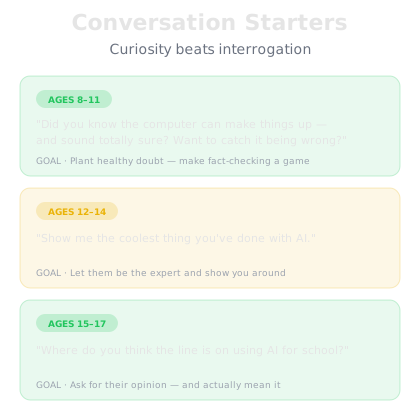
You don't need the perfect script — you need an opener that makes conversation two more likely than silence.
Knowledge Check
Your teen shows you an AI chat that worries you. What's your first move?
A
Stay calm, ask questions, and keep them talking — they just showed you voluntarily, which is exactly the behavior you want more of
B
Tell them AI is now off-limits until they're older
C
Take the phone and read the full history while they wait
D
Say nothing now, then quietly install monitoring software later
A kid who shows you something worrying just did the single most valuable thing they can do — brought it to you. React with confiscation or punishment and it's the last thing they ever show you. Stay curious first; decide on rules after you actually understand what you're looking at.
The same conversation, two ways
Here's how this plays out over text. A parent finds out their 14-year-old has been using ChatGPT for history homework. Watch the curious approach — and notice the confiscation version of each message would have ended the exchange in one reply.
Hey, your teacher mentioned some kids are using ChatGPT for the history essays. You've used it right?
...maybe? am i in trouble
No. Genuinely curious. What do you use it for?
mostly when the textbook makes no sense lol. i ask it to explain stuff like i'm 12
and sometimes to check my essays before i hand them in
That's actually smart. Can you show me the explain-it-like-I'm-12 thing tonight? I want to try it on my work emails 😅
omg yes you're going to love it
ok but don't tell it to write the emails FOR you, ms. rivera says that's where people get caught 💀
Deal. So where's the line for essays? Checking is fine but writing them is not?
yeah basically. it can explain and check my stuff but if it writes it that's cheating
some kids do it anyway but it's obvious, the essays don't sound like them at all
↻ Replay conversation
Final Check
In that exchange, what did the parent do that a "confiscation approach" parent wouldn't have?
A
Checked her chat history to verify what she said
B
Immediately set a screen-time limit for ChatGPT
C
Asked to be shown how it works and let the teen be the expert — which got the teen to volunteer where the cheating line is on her own
D
Warned her that AI chats are monitored by the school
The parent asked questions, showed genuine interest, and even asked the teen to teach them something. Result: the teen volunteered the exact information a lecture was supposed to deliver — where the line is — and stated it as her own rule, which means she's far more likely to keep it.
Keep the door open
One conversation doesn't finish the job — AI changes too fast for that. What you're building is a standing channel: a kid who mentions the new chatbot at school, shows you the weird image trend, asks you whether something counts as cheating. Every calm reaction is a deposit in that account. Every overreaction is a withdrawal.
You don't have to like everything you hear. You just have to be hearable about it.
💬
Day 5 Complete
"Your goal isn't to police AI. It's to be the person your kid talks to about it."
Tomorrow — Day 6
AI Companions & Chatbot Friends
Tomorrow you'll learn how companion chatbots are designed for emotional engagement — and which warning signs actually matter.