Your Credit AI Toolkit (and Ground Rules)
Yesterday you saw the opportunity: hours of information work at every lifecycle stage that AI can compress into minutes. Today you get equipped — and, more importantly, you learn the ground rules that let you use these tools without ending up in a meeting with compliance.
Because here's the truth about this course: the tools take an afternoon to learn. The data discipline is what separates the professional from the person who becomes a cautionary tale in next year's staff training.
The big three assistants
You don't need special software to start. Three general-purpose AI assistants cover almost everything in this course:
ChatGPT (OpenAI) — the most widely used, strong at structured analysis and drafting. Claude (Anthropic) — excellent with long documents, careful reasoning, and nuanced tone in customer communications. Gemini (Google) — tightly integrated with Google Workspace if that's your world.
All three do the work in this course well. What matters far more than which one you pick is which tier you're using:
Consumer tiers — the free or personal accounts you sign up for yourself. Convenient, but your bank almost certainly hasn't approved them for anything involving borrower data, and depending on settings, what you type may be used to improve the model.
Enterprise tiers — business versions your employer contracts for, typically with data protection commitments, no training on your inputs, and admin controls. This is what banks and lenders roll out when they approve AI use.
Your first move is a question, not a prompt: ask your manager or IT which AI tools are approved at your institution, and under what conditions. If there's an approved enterprise tool, use it. If there isn't, you can still practice everything in this course with synthetic data on a consumer tool — which brings us to the rule that governs everything else.
The PII rule: anonymize before you paste
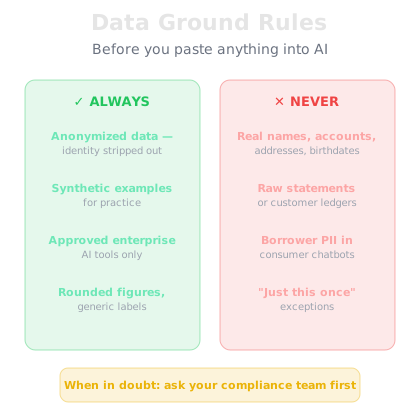
Here is the one rule in this course that is genuinely non-negotiable: never paste real borrower or customer data into a consumer chatbot. No names, no account numbers, no addresses, no dates of birth, no raw bank statements, no ledgers. Not once, not "just this time," not because the deadline is tight.
Why so absolute? Because borrower data is regulated personal data, and once it leaves your institution's controlled environment, you can't get it back. Data protection law, banking confidentiality, and your own employment contract all point the same way — and regulators have little patience for "the chatbot made me do it."
The good news: anonymized data works almost as well. The AI doesn't need to know it's analyzing "Sarah Milton, account 4471…" to spot an income pattern. It needs dates, amounts, and descriptions with identity stripped out:
Instead of: real name, account number, employer name, exact address.
Use: "Applicant A," "Employer (manufacturing, ~200 staff)," "monthly salary credit," rounded figures where precision doesn't matter.
For practice — like this course — go one step further and use fully synthetic data: invented statement lines that look realistic but belong to no one. Every example in these lessons is synthetic. Yours should be too, until you're inside an approved enterprise tool with clear internal guidance. And even then, follow your institution's policy — check with your compliance team about what may be shared, anonymized or not.
Three prompts to try today
Enough rules — let's get your hands dirty. Three safe, high-value prompts you can run today with public or synthetic material:
1. Summarize a policy document. Take a public lending policy, regulatory guidance note, or your institution's published terms and ask: "Summarize this document in plain English for a new credit analyst. List the 5 rules most likely to affect day-to-day underwriting decisions."
2. Explain a covenant. Paste a standard covenant clause from a template (not a live agreement) and ask: "Explain what this covenant requires, what would breach it, and what a lender typically monitors to check compliance."
3. Draft a customer email. "Draft a polite, professional email to a business customer whose account has gone 10 days past due for the first time. Friendly tone, clear ask, offer to discuss. Keep it under 120 words." Then edit it into your voice — and remember, nothing AI drafts goes to a real customer without a human reviewing and sending it.
Your toolkit, assembled
That's the whole kit for now: one approved assistant, the anonymize-before-you-paste rule, and three prompts that already save you time this week. Notice the pattern in the chat demo — the AI summarized, flagged, and suggested what to verify. It didn't score the applicant, didn't recommend approval or decline, and the human keeps every decision. That division of labor is permanent.
Tomorrow we go under the hood: what's actually inside an AI credit scoring model, and why understanding it matters even if you never build one.