How AI Thinks (and Why It Lies)
You don't need to understand engines to drive a car. But you absolutely need to know that cars can skid. Today you get the one mental model that explains both the magic and the failures of AI — in plain English, no math, no jargon.
By the end of this lesson you'll understand something most people using AI every day still don't: why a chatbot can write a beautiful essay and still confidently invent a book that doesn't exist.
AI is very, very good autocomplete
You know how your phone suggests the next word while you type? A chatbot like ChatGPT is that same idea, scaled up enormously. It was trained on a huge portion of the internet — books, articles, websites, conversations — and it learned one skill to a superhuman level: predicting what words should come next.
That's it. That's the whole trick.
When it "answers" your question, it isn't looking anything up in a database of facts. It breaks your message into tokens (roughly word-sized chunks) and generates the most plausible-sounding continuation, one token at a time. Because it absorbed patterns from millions of real explanations, the plausible answer is usually also the correct one. That's why it feels like talking to something that knows things.
But hold onto this: producing plausible text is not the same as knowing. There's no fact-checker inside. There's no "I'd better not say this unless I'm sure." There's just prediction.
Hallucinations — confident and wrong
When AI doesn't have a good pattern to draw on, it doesn't say "I don't know." It does what it always does: it generates something plausible. A date that sounds right. A quote that sounds like the author. A citation formatted perfectly for a study that was never conducted.
This is called a hallucination, and here's the dangerous part: a hallucinated answer arrives in the exact same fluent, confident tone as a correct one. No stutter, no hedge, no warning label. You cannot tell the difference by reading it.
It's not lying in the human sense — there's no intent to deceive. It's the world's most confident guesser doing the only thing it knows how to do. But the effect on you is the same: wrong information delivered with total conviction.
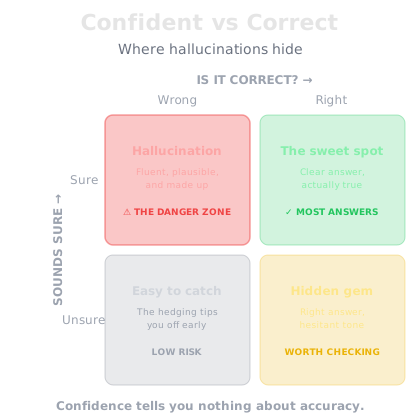
Reading about hallucinations is one thing. Watching one happen is another. Here's a demo you can repeat yourself tonight:
The rule that changes everything
Here's today's entire lesson in one sentence: treat AI like a brilliant intern. Astonishingly fast, tireless, great with words — and capable of confidently inventing things, so anything important gets double-checked before it ships.
That analogy will carry you through all 28 days. It doesn't make AI scary, and it doesn't make it an oracle. It makes it what it actually is: a powerful tool with a known failure mode. Once you know the failure mode, you can use the power without getting burned.
Go deeper
This mental model comes from our family and beginner tracks, and the ChatGPT Masterclass takes it much further — how models are trained, what they can and can't do, and every major feature explained. It's the natural deep-dive once you finish these 28 days.
Tomorrow: hands-on. You'll pick your AI assistant and set up your toolkit in about two minutes.